This post details how to travel overland on the Karakoram Highway and Khunjerab Pass, with public transport from the Gilgit-Baltistan region of Northern Pakistan, into China, and on to Kashgar.
Visas
We applied online for a Pakistan eVisa. This was a quick process, it’s free for a large range of countries, and gives you 90 days to explore Pakistan.
For China, we used the visa free 30 days available for citizens of many EU countries and more. No documents were required at the border, but a few questions were asked about our travel plans in Xinjiang.
The Karakoram Highway and Khunjerab Pass – from Sost to Tashkurgan
Sost is the last town in Pakistan before the Karakoram Highway climbs up to the Khunjerab Pass.
For practical information on how to get to Sost from Lahore and Islamabad, check out our post on Pakistan.
At 4,693m, the Khunjerab Pass is the world’s highest paved border crossing. The only way for independent travellers, without their own vehicle, to cross the border is with an official bus. NATCO (Northern Areas Transport Company) runs the busses from the Pakistani side. Tickets can be purchased in advance, or the day of, at the NATCO office in Sost. We paid 10,000 Pakistani rupees per person for the ticket through to Tashkurgan. The bus doesn’t leave the office each morning until around 10, but it’s good to be there around 9 to get your seats.
Note that cyclists can’t cross the border on their bikes, you’re forced to take the bus. The NATCO minibus took our friends bikes on the roof rack without any trouble.
Note also that the Khunjerab border is closed on weekends and public holidays.
The first stop on the bus journey is just 100m down the road from the NATCO office, at the Pakistani customs and immigration. This was an easy process, you have to go into the customs office with all your luggage, then on to immigration next door.
The bus then stops at the office of the Khunjerab National Park and all passengers must pay the entrance fee, even though you only get to experience the national park from the bus window. At time of travel, entry was USD30 per person, or equivalent in rupees. Better than the USD40 per person that some traveller’s had paid a few months prior, but a huge increase compared to a few years ago. Cash only at time of travel.
The Karakoram Highway is magnificent along all its entire length, but it gets increasingly wild and remote on the way up to the Khunjerab Pass. We crossed in early April and there was still plenty of snow. Previously the Pass and border was closed in winter, through to 1 April, or even 1 May for certain vehicles. However it was recently announced that the Khunjerab Pass will now remain open all year.
Chinese border control
A huge concrete arch emblazoned with a red star greets you at the top of the pass, with razor wire marking the border on the flanking mountains. Welcome to China!
Chinese customs officials were very friendly, but very very thorough. We had to take all our luggage through x-ray scanners then open our bags taking absolutely everything out. Customs went through absolutely every item we had, leafing through all books, asking questions, translating a newspaper we had, and all paperwork we were carrying. I was worried about our small 3cm blade pocket knife but this wasn’t picked up, no issues with our gas camping stove, gas canister, tent or a Pakistani carpet!
After customs, you load back onto the bus with your gear, and a Chinese immigration officer, for the trip to Tashkurgan, as Chinese immigration is in Tashkurgan. Apparently no one can get out of the bus, even to pee, between the Khunjerab Pass and Tashkurgan immigration.
Immigration in Tashkurgan was an easy process, although we were disconcerted by Chinese officials forcing everyone to take ‘Covid tests’ in April 2025… I think this is more about DNA collecting. It all happened before I could think to try and say no, so I can’t advise on what happens if you object.
There is another less intense bag check before you’re let free, all fresh fruit has to be eaten or thrown out here.
Just next to the immigration office there’s a tourist information centre that can sell and help set up a Chinese SIM card if needed.

Tashkurgan and on to Kashgar
Tashkurgan is a predominantly Tajik town, but feels very very Chinese after coming across from Pakistan.
The going rate for a bed in a hostel is around 45-50 yuan. We stayed at the ‘On the Road Hostel’, it was very clean and comfortable, and even had an espresso machine! Booking accommodation on Trip.com is the easy way to go, and often cheaper than booking directly with the hostel/hotel!
Having Alipay or Wechat set up is the best way to go for payments anywhere in China, although we found cash is also generally accepted. This post on China explains how to set up payment apps, as well as how to book trains.
I recommend visiting the old fort, it’s a pretty impressive site with the magnificent mountain backdrop. The entrance to the fort ‘scenic area’ is here and costs 51 yuan per person.
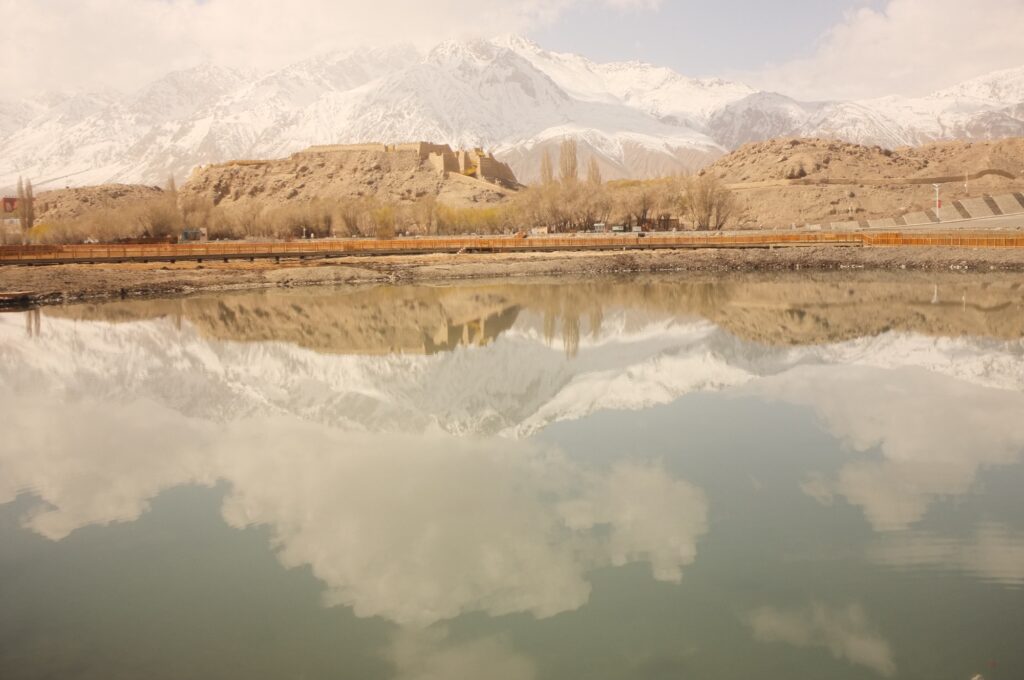
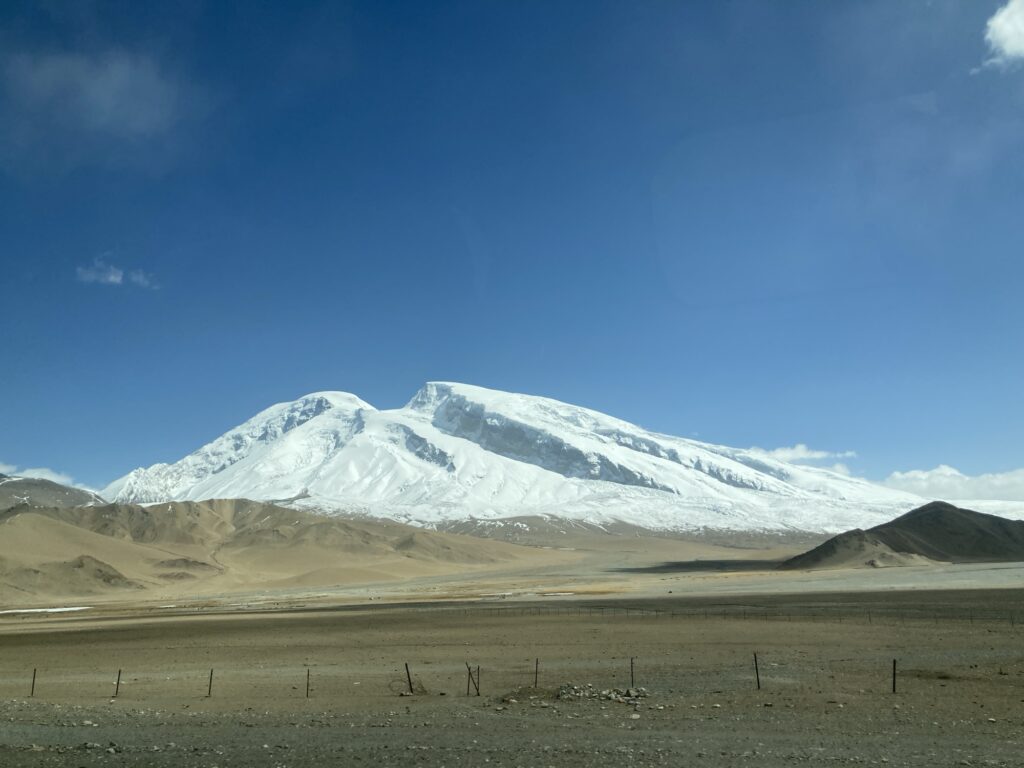
Travelling on to Kashgar takes 6-7 hours, with magnificent scenery along the way. Shared taxis cost 100 yuan, the hostel owner organised it for us, otherwise you can just walk down the main street and ask people waiting around vans.
Friends also successfully hitch hiked to Kashgar, while others cycled. Both are better options than a shared taxi as you can stop to admire the view!
Kashgar
Kashgar is another city disneyfied in the Chinese manner. The vast majority of the old city was knocked down in 2007-2008 and rebuilt in order to make the town more ‘earthquake safe’. Suffice to say, if you’re going through Xinjiang you should absolutely research the history and current reality of relations between the Uyghur people and the Chinese state.
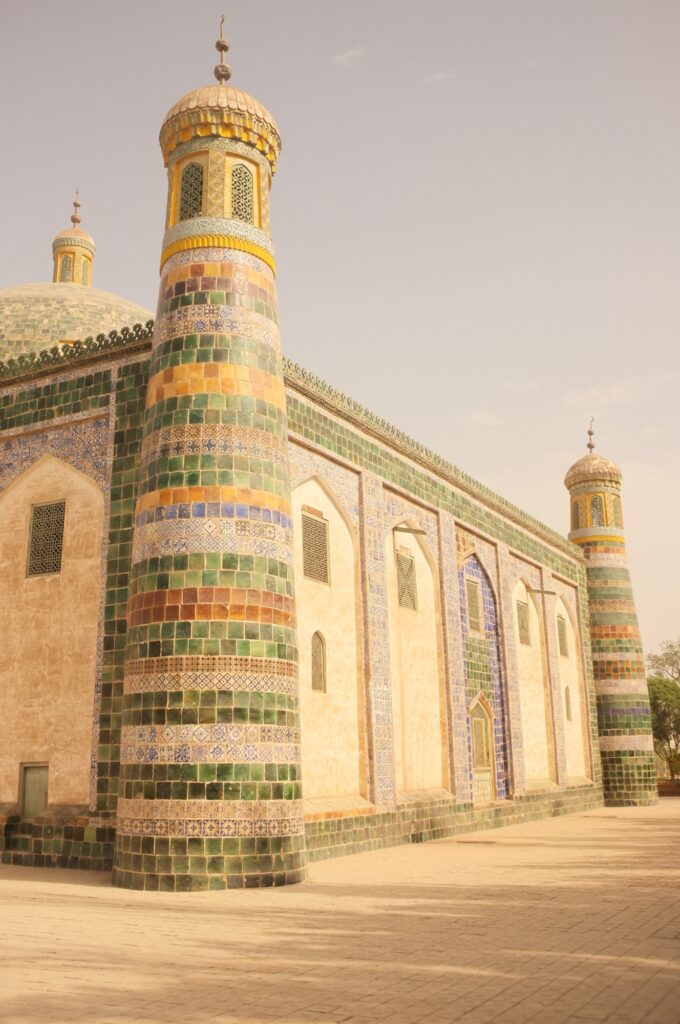
We recommend visiting the Abakh Hoja Mausoleum , now known as the ‘Fragrant Imperial Concubine Scenic Spot’ Throughout Xinjiang Uyghur mosques have been destroyed or heavily modified, but here the architectural beauty of the original mausoleum and accompanying mosque remains, albeit surrounded by the new additions of the ‘scenic area’
Another highly recommended experience in Kashgar is a visit to the Kashgar Sunday livestock market. This bustling market brings together Uyghur farmers from the sur area, with hundreds of horses, cattle, donkeys, goats, AND, fat tailed sheep, changing hands. There are plenty of food options, notably Uyghur specialties. For many sheep the onward journey from the market is a very short one…
For information on how to travel from Kashgar to Osh in Kyrgyzstan, via the Irkeshtam border, see our blog post here.